As I’ve mentioned in previous posts, I’ve fished on different occasions in the Florida Keys. The Keys is a beautiful, and at times, a unforgiving SOB. It’s hard on your emotions, sanity, and especially your gear. The environment and it’s inhabitants must be met with the sturdiest of gear. I am a firm believer in, “You get what you pay for”. I have no issues spending money on gear. I would rather invest a good portion of my hard earned money on quality, tried and true equipment. Which brings me to the Scott Meridian fly rod.
The Scott Meridian is a true saltwater rod and 2015 IFTD “Best of Show” winner. This is a rod that comes in at a premium price, $865. This is not a cheap investment, but one you’ll be glad you made. The Scott Meridian has premium components, a “saltwater” wells cork grip, a solid reel seat with fighting butt, aesthetically pleasing blank, quality guide wraps, and a beautiful natural finish. Let’s also add that this rod is an American product, handcrafted right in the USA. Scott’s base of operations is in Colorado. Scott handcrafts all their rods, making sure to hit all the details.
The Aesthetics
Let’s talk about the aesthetics first. Scott has chosen not to sand and paint this rod. Giving it a natural finish. Scott rod designers believe that a rod should be judged by it’s performance, not it’s looks. That being said, this is a very beautiful rod. The natural carbon fiber look is accented by blue thread on the guide wraps. Also, the white hand painted Scott logo with rod model, length, and rod weight. Scott has also laser etched their logo on the reel seat, and have also laser etched the rod weight right on the reel locking ring, which allows you to grab the right weight rod on the skiff quickly.
The Components
Scott has chosen to use titanium recoil snake guides on this rod. This rod is also fitted with two large stripping guides towards on the first section of the rod. The use of the titanium guides adds strength, reduced weight and extreme corrosion resistance. The two stripping guides are lined with a Silicon Carbide. This material is extremely durable and doesn’t crack under intense temperature extremes. The reel seat is designed from mil-spec III aluminum, which is an extremely corrosive resistant aluminum. Without getting to technical about the reel-seat, the mil-spec III is an aluminum that goes through a more intense galvanizing process.
The Technology
This rod is technologically advanced, as far as rods go. Scott uses x-core technology and ARC carbon reinforcement in their blanks. This process creates a very strong and durable blank. Scott also doesn’t skimp on castablility and feel in the Meridian. The have incorporated ReAct technology in the rod blank. the ReAct technology ensures that energy generated during your cast isn’t lost to unnecessary vibration throughout the blank. The coupled with x-core technology makes sure that energy is transferred more efficiently from your casting stroke, through the blank, to your line for a eloquent presentation.
My experience with the rod
Now that i’ve gotten the technical jargon out of the way, let’s talk about how the rod performed. Now, I will note that I am not the best caster, but I am also not the worst. Saltwater fly fishing will test even the very best of anglers, which is an important bit to remember when evaluating your gear. If the gear isn’t doing what you’ve expected it to do, it’s probably the user. That being said, quality gear can make your job a lot easier. Especially in unforgiving environment. Rod’s definitely are an extreme factor in quality casts. However, something that most anglers neglect to look at is the line their using. A good rod is nothing without properly matched line. I personally prefer a shorter shooting head for distance casts, especially in saltwater.
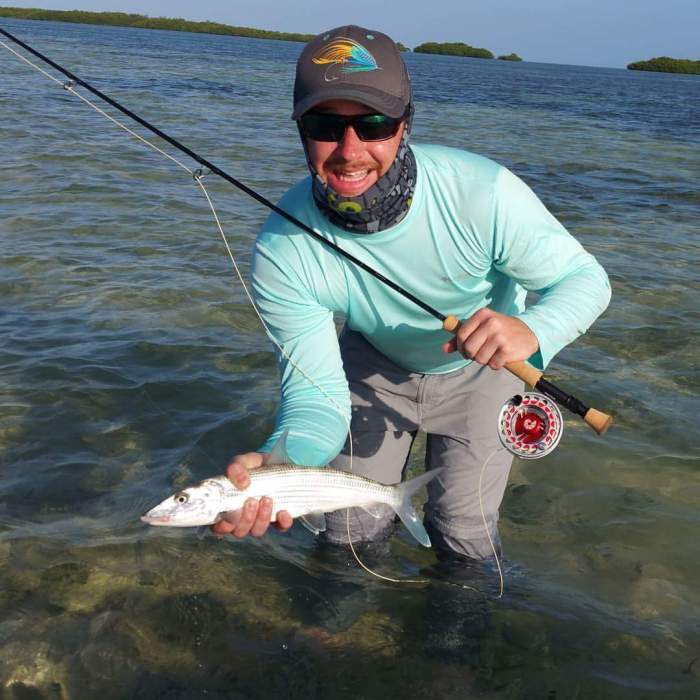
During my time in Key West, I was using RIO bonefish taper line on a nautilus CCFX-2 6/8. This was/is my go to combo for bones. The Scott Meridian performed flawlessly. The rod loads quickly and allows for quick casts that are essential on the flats. Most of the time you are making quick casts at various distances. With little opportunity to make several false casts, you need a rod that loads and shoots line out quick and fast. This rod does just that. The Meridian is a fast action rod, with plenty of backbone to make those quick casts. I would also like to add that this is an accurate rod. It will put your fly where you want it when you want it there. It casts various saltwater flies very well. I was casting mainly shrimp patterns, which are pretty streamlined compared to crab patterns. Like most saltwater flies, I was casting weighted shrimp and crabs. The Meridian handled these with ease. The rod presents delicately, but also has enough backbone to launch those weighted flies precisely where you want them.
Every rod performs differently at different distances. Some rods perform well in the 30-40ft range, others at longer distances. I have to say that this rod performs well at all distances. However, that being said, this rod performs its best at 50-60ft. I could send a fly in a tight loop and turn it over well at this distance. Put the rod in a different person’s hands and the result will inevitably be different.
The Meridian is satisfyingly light in hand, which causes less fatigue. The power of this rod is surprising for how light it is. That is a rare thing to have sometimes. You usually sacrifice one for the other. This is not the case with the Scott Meridian.
Dislikes
I really only have two major complaints about the rod. 1st, the price. At $865, this is not a cheap investment. Especially for the occasional saltwater angler. You could go with a more median priced Sage Motive at $450 (Which I have in a 9wt, I’ll review that a different time), or a lower entry level priced TFO Mangrove or TiCr X rods, both ranging from $259-$299 depending on rod weight. This is in the same category of premium salt rods as the Sage Salt and the G-Loomis NRX, with the NRX being the more veteran rod in this category. I chose the Scott simply for the fact that it seemed every one had the Loomis and I wanted something different. Also winning the IFTD “Best of Show” in 2015 didn’t hurt either. My 2nd complaint is the size of the lock ring on the reel seat. It is a bit small and gets stuck on beefier reels such as the CCFX-2. Other than that the rod is spot on.
Overall Rating
Overall I give the Scott Meridian a solid 9.5 out 10. Losing half a point for the price and the smallish reel seat. This rod is, for lack of a better term, sexy. The aesthetics and performance are unmatched. Scott is a stellar company turning out solid products. If you’re in the market for a saltwater rod and don’t have an issue with shelling out $865 bucks, then go with the Scott Meridian.


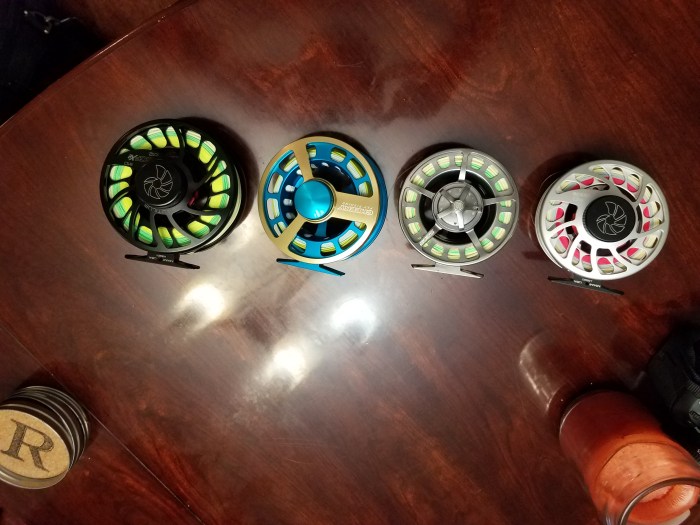
 Cheeky is a relatively new company that debuted their first line of reels in 2008. The Mojo 425 is in their performance line of reels. They also have a more inexpensive line of reels in the Boost line and Tyro line of reels. I currently own a boost 325 on my 4wt. The boost has a smooth drag and low startup inertia. Just playing with Mojo 425 doing some strips of the line indicated to me that the drag is as smooth or smoother than the boost. The reel also seems to have a very low startup inertia, if there is any. I’m sure you’re asking yourself what is “startup inertia”. Startup inertia is the amount of energy that is required to get the reel spool moving. The higher the startup inertia, the more energy it takes for the reel to get going. A low startup inertia is essential for species where long runs are common (i.e. bonefish, permit, steelhead, salmon, stripers, tarpon etc.). Speaking of startup inertia, lets talk drag. The Mojo 425 has a larger drag knob which is a nice feature to have a on a reel for larger fish. It’s nice to have a large drag knob when playing a drag on a large fish. This becomes common once you start chucking flies in salt or hook into large salmon and steelhead.
 So how does the Mojo 425 stack up initially? Initially I have to say the Mojo 425 is an impressive piece of hardware. I am basing this on the comparison of two other reel brands in this class, Nautilus and Sage. I have used the Nautilus CCFX-2 in size 8/10 and 6/8. I have also used the Sage 4280. The CCFX-2 is my go to salt water reel. I have used the 8/10 and 6/8 for bonefish, permit, snook, and sea-trout in the Florida Keys. The 6/8 is a great reel for bonefish and permit (of moderate size). The line pickup on the 6/8 was great, Nautilus drags are some of the best on the market in terms of stopping power. The drag knob is large and nice to have when playing large fish. The 8/10 is another great salt reel, which I have converted to a freshwater reel for my switch rod this winter. The 8/10 has a significantly larger arbor for faster line pickup. Both the 8/10 and 6/8 have low startup inertias, smooth drags, and great stopping power. The drag knob is also a pain sometimes. Even thought he large drag knob is nice for playing fish on the drag, it is also a pain in the fact that line wrapped around the drag knob can crank the drag on accident and lower its tension. This happened to me more than once in the Keys, thankfully not with a fish on. The drag knob is a catch 22. Which I hope won’t be the case with the Mojo 425, due to it’s lower profile drag knob.


 Reff Water Fly Fishing LLC